
Progressive Die Stamping vs. Transfer Press Stamping
Metal stamping is an essential process in manufacturing, playing a critical role in the automotive, HVAC, and plumbing industries, as well as beyond. Two of the most widely used techniques in metal forming are progressive die stamping and transfer press stamping. Both methods offered by our metal stamping manufacturer may differ but do still have distinct advantages, making them suitable for a range of applications.
Here’s what you need to know about these techniques so you can choose the best solution for your custom components.
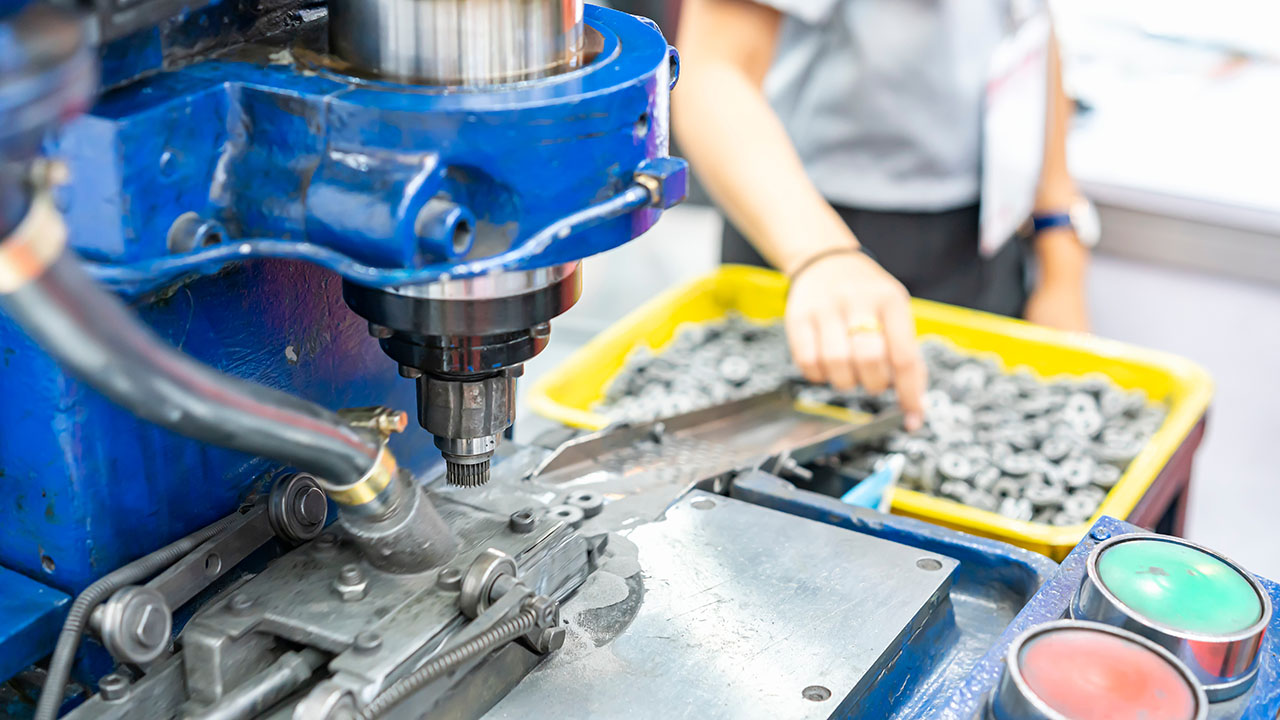
What Is Progressive Die Stamping?
Progressive die stamping, often referred to as progressive stamping, is a continuous metal forming process used to produce high-volume parts quickly and efficiently. This technique involves feeding a coil of metal strip through a series of stations in a single die. Each station performs a specific operation, such as cutting, bending, or punching, progressively shaping the part as it moves through the die.
At the final station, the completed part is separated from the strip. This process is ideal for producing parts with intricate shapes, tight tolerances, and complex geometries. Progressive die stamping is widely used in industries where high-volume production, consistency, and efficiency are critical.
Benefits of Progressive Die Stamping:
- Cost-Effective: Ideal for large production runs, progressive die presses minimize waste and reduce labor costs due to their high-speed automation.
- Precision and Consistency: Delivers consistently accurate parts with minimal variation, ensuring reliable quality for each unit.
- Versatility: Capable of handling complex designs, progressive die stamping is perfect for components requiring multiple forming operations in a single pass.
- Efficiency: The continuous nature of the process allows for rapid production, reducing lead times and increasing output.
What Is Transfer Press Stamping?
Transfer press stamping, also known as transfer stamping or transfer die stamping, is another metal forming method that differs significantly from progressive stamping. In this technique, individual blanks or pre-cut pieces of metal are loaded into the press, where they are moved from one station to another by a series of transfer mechanisms. Each station performs a specific operation, such as drawing, bending, or forming, to shape the part.
Transfer press stamping is particularly effective for producing large, deep-drawn metal parts that require multiple forming stages. This method is commonly used in applications that demand complex shapes, thicker materials, or components with deeper draws, such as those used in deep draw metal stamping.
Benefits of Transfer Press Stamping:
- Flexibility: Allows for more complex part designs and deeper draws than progressive die stamping, making it ideal for large, intricate components.
- Material Versatility: Can handle thicker and tougher materials, which are often used in heavy-duty applications.
- Custom Metal Stamping: Transfer presses provide more control over each stage, enabling greater customization of part designs.
- High Precision: Ensures accuracy for components that require deep draws and complex shapes without compromising on quality.
Key Differences Between Manufacturing Methods
While both methods are essential to precision metal stamping, they are suited to different types of projects based on several factors:
| Feature | Progressive Die Stamping | Transfer Press Stamping |
| Part Complexity | Ideal for high-volume, simple to moderately complex parts | Best for large, deep-drawn, and highly complex parts |
| Material Thickness | Suitable for thin to medium materials | Handles thicker, more robust materials |
| Production Volume | High-volume, continuous production | Medium to high-volume, batch-based |
| Design Flexibility | Limited customization due to fixed die stations | High customization potential with independent stations |
| Cost Efficiency | More cost-effective for long production runs | Higher initial setup cost but efficient for custom parts |
Partner with Us for Your Next Metal Stamping Project
Choosing the right metal forming method is crucial to achieving the quality, performance, and cost-efficiency your project demands. Our global metal stamping company is dedicated to helping you select the best approach for your unique requirements so, if you’re ready, fill out our online contact form today to start the discussion on how Trans-Matic can help you achieve your manufacturing goals with precision and reliability.
